

Serum Lactate Dehydrogenase as a Potential Biomarker for Lateral Lymph Node Metastasis in Thyroid Cancer Patients After Total Thyroidectomy
DOI:
https://doi.org/10.14740/jcs1035Keywords:
Lactate dehydrogenase, Thyroid cancer, Postoperative surveillance, Lymph node metastasisAbstract
Background: This study aimed to investigate the clinical significance of serum lactate dehydrogenase (LDH) as a potential biomarker in patients with thyroid cancer, particularly in association with lateral lymph node metastasis (MLN) after total thyroidectomy.
Methods: A total of 2,560 patients with thyroid tumors were divided into benign group (n = 612) and malignant group (n = 1,948). Serum LDH and thyroid-stimulating hormone (TSH) levels were measured within 3 days before surgery. Within the malignant group, three subgroups were further analyzed: cancer subgroup, n = 1,820; MLN subgroup, n = 50; and cancer + MLN subgroup, n = 78. Statistical analyses included t-tests, Chi-square tests, and one-way analysis of variance (ANOVA) with Tukey’s post-hoc tests, multivariable logistic regression, and receiver operating characteristic (ROC) curve analysis.
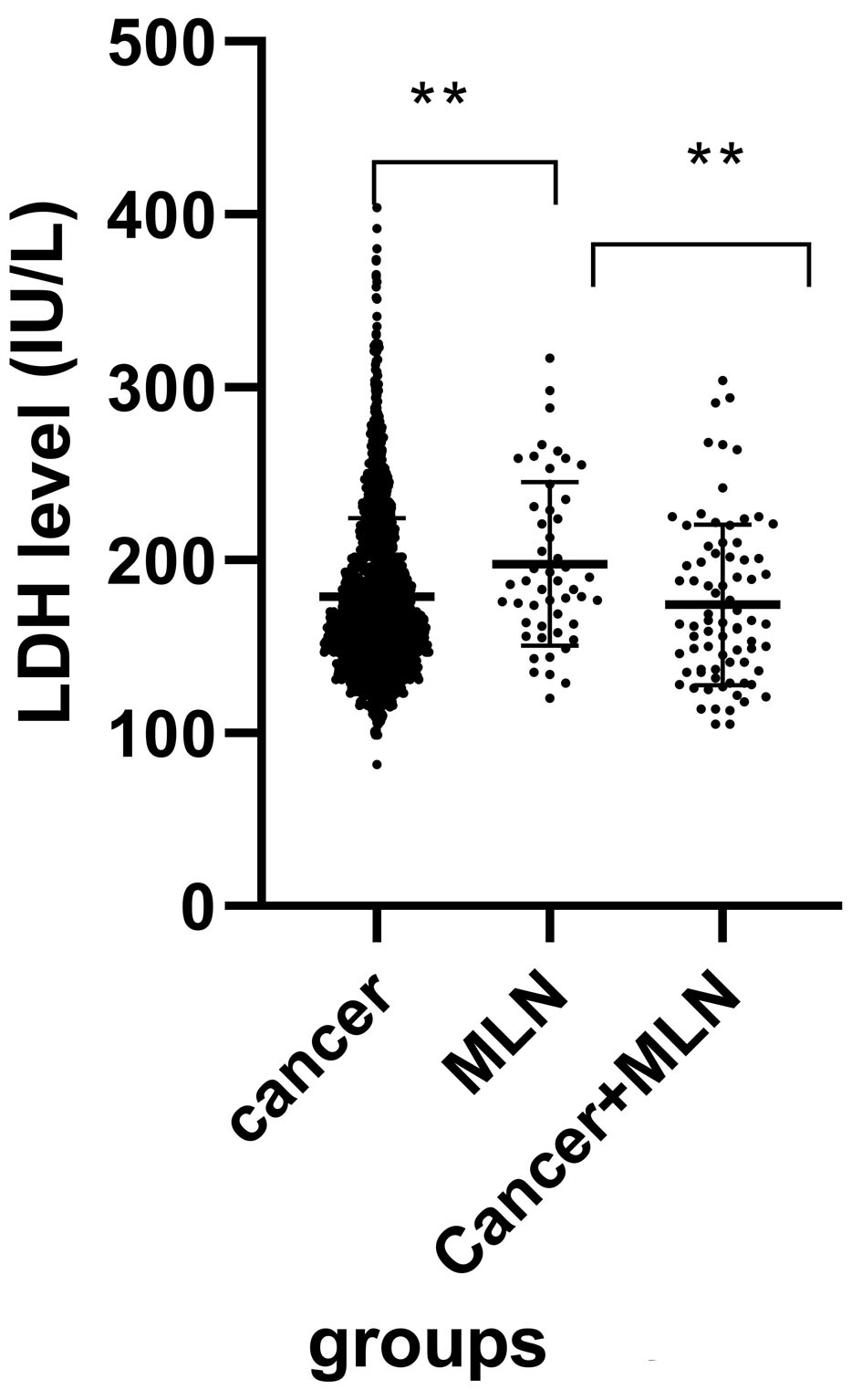
Results: Compared with the benign group, patients in the malignant group were younger (t = 13.79, P < 0.001), had higher body mass index (BMI, t = 1.97, P = 0.049), a greater proportion of males (χ2 = 4.35, P = 0.037), and lower levels of both TSH (t = 6.72, P < 0.001) and LDH (t = 3.12, P = 0.002). Subgroup analysis within the malignant group revealed that the MLN subgroup had significantly higher LDH levels (197.9 ± 47.14 IU/L) compared with both the cancer subgroup (178.9 ± 45.58 IU/L, t = 2.90, P = 0.004) and the cancer + MLN subgroup (174.3 ± 46.49 IU/L, t = 2.79, P = 0.006). No significant difference was observed between the cancer and cancer + MLN subgroups (P = 0.58). Multivariable logistic regression confirmed that LDH remained independently associated with MLN status after adjusting for age, sex, and BMI (odds ratio (OR) = 1.011, 95% confidence interval (CI): 1.004–1.018, P = 0.002). ROC analysis yielded an area under the curve (AUC) of 0.628 (95% CI: 0.553–0.702), with an optimal cut-off of 187.5 IU/L (sensitivity 56.0%, specificity 63.6%).
Conclusions: While serum LDH levels are lower in patients with newly diagnosed thyroid cancer compared with those with benign tumors, a significant elevation in LDH is observed in patients who develop lateral cervical MLN after total thyroidectomy. These findings demonstrate an association between elevated serum LDH and lateral neck recurrence, suggesting that LDH may serve as a useful adjunctive biomarker for monitoring lateral MLN during postoperative follow-up in thyroid cancer patients. Further prospective studies with serial LDH measurements are warranted to validate these findings.
Published
Issue
Section
License
Copyright (c) 2026 The authors

This work is licensed under a Creative Commons Attribution 4.0 International License.