

Early Surgery in Crohn’s Disease: Clinical and Evolutionary Profile
DOI:
https://doi.org/10.14740/jcs1047Keywords:
Crohn’s disease, Surgery, Clinical pathwayAbstract
Background: Crohn’s disease (CD) is a chronic condition with increasing prevalence, where early management is crucial for improving long-term prognosis. This study aimed to assess the rate of early surgery, identify associated factors, and compare the outcomes of patients undergoing early surgery, late surgery, and those treated medically.
Methods: We conducted a retrospective single-center study of 120 CD patients hospitalized at Mohamed Taher Maamouri Hospital between 2012 and 2023. Early surgery was defined as intestinal resection within 12 months of diagnosis. Three groups were defined: early surgery, late surgery, and no surgery. Clinical characteristics, predictive factors, and long-term outcomes, were analyzed using multivariable logistic regression and Kaplan–Meier survival analysis.
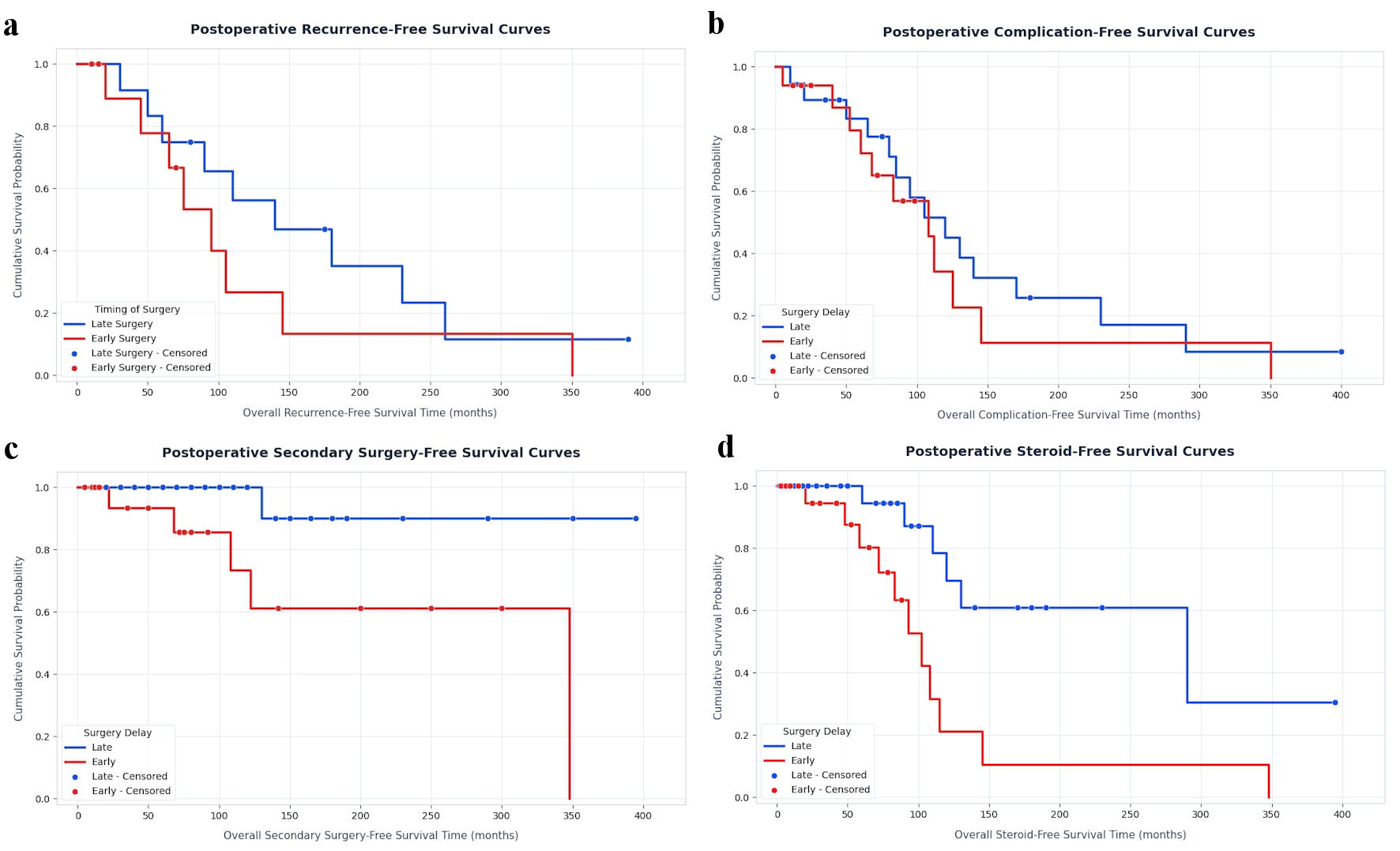
Results: The mean age was 39 years, with a male-to-female ratio of 1.22. Surgery was performed in 47.5% of patients (n = 57), with 25.8% (n = 31) undergoing early surgery. Twelve patients (10%) had surgery at diagnosis, mainly due to acute intestinal obstruction. Ileocecal resection was performed in 77.2% of cases. Postoperatively, 53.7% achieved durable clinical remission, while 24.5% had postoperative adverse outcomes. Multivariate analysis identified a complicated onset (P = 0.02) and no initial corticosteroid use (P = 0.016) as factors associated with early surgery. Although overall follow-up duration was longer among patients undergoing early surgery, recurrence-free, postoperative adverse event-free survival, corticosteroid-free, and reoperation-free survival were significantly longer in the late surgery group. The no surgery group had shorter survival, though this difference was not significant (P = 0.9).
Conclusions: In our cohort, patients undergoing early surgery frequently presented with complicated diseases requiring urgent surgical intervention. Consequently, the less favorable long-term outcomes observed after early surgery probably reflect greater disease severity at presentation rather than the timing of surgery itself. These findings should therefore be interpreted cautiously, particularly when comparing our cohort with populations managed in healthcare systems where earlier diagnosis and wider access to biologic therapy are available.
Published
Issue
Section
License
Copyright (c) 2026 The authors

This work is licensed under a Creative Commons Attribution 4.0 International License.