


Adult Splenic Flexure Colocolic Intussusception Due to a Submucosal Colonic Lipoma Presenting as Acute Abdomen
DOI:
https://doi.org/10.14740/jcs1045Keywords:
Adult intussusception, Colocolic intussusception, Splenic flexure, Colonic lipoma, Submucosal lipoma, Acute abdomen, Left hemicolectomy, Lead point lesionAbstract
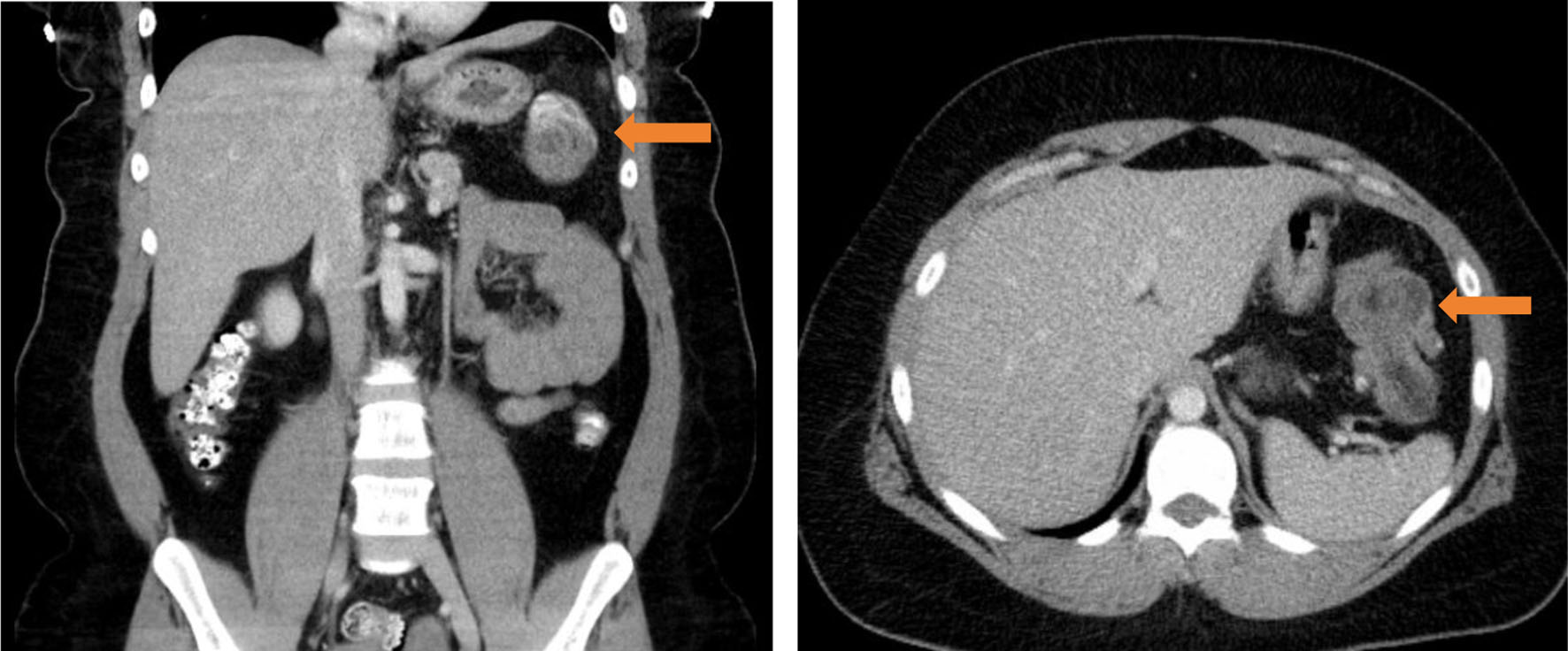
Adult intussusception is uncommon and usually results from an underlying structural abnormality, particularly in the colon, where malignancy is a major concern. We present a case in which a young woman experienced 4 days of crampy lower abdominal pain, constipation, nausea, vomiting, and inability to pass flatus. Abdominal examination showed tenderness, hyperactive bowel sounds, and no distention; vital signs were stable. Laboratory tests were largely unremarkable, including a white blood cell count of 9.3 × 10⁹/L. Contrast-enhanced computed tomography of the abdomen identified a 9 cm colocolic intussusception at the splenic flexure, led by a 6 cm fat-containing lesion. Follow-up CT showed ongoing intussusception, bowel wall thickening, and a 7.2 × 3.8 cm fat-density lesion, confirming a fixed lead point. After a gastroenterology and surgical consultation, a laparoscopic left hemicolectomy was performed. Intraoperative findings confirmed intussusception, and histopathology revealed a benign submucosal colonic lipoma. This case underscores the rare occurrence of splenic flexure intussusception caused by a large submucosal lipoma, underscoring that persistent intussusception with a risk of malignancy warrants surgical management. Colonic lipoma should be considered in the differential diagnosis of adult colocolic intussusception, especially when malignancy cannot be excluded preoperatively.
Published
Issue
Section
License
Copyright (c) 2026 The authors

This work is licensed under a Creative Commons Attribution 4.0 International License.